
Educational Benefits of Skiing in Primary and Secondary Education: The Real Educational Value of a School Trip to the Snow
A school trip to the snow should not be understood only as a recreational activity or an end-of-year trip. When structured with professional planning, technical supervision and a clear methodology, it becomes an educational experience with a real impact on the academic, social and personal development of the students.
The combination of technical ski classes, continuous coexistence, organized routine and constant supervision transforms the experience into a comprehensive training tool that goes far beyond sport.
Structured physical activity with real progression
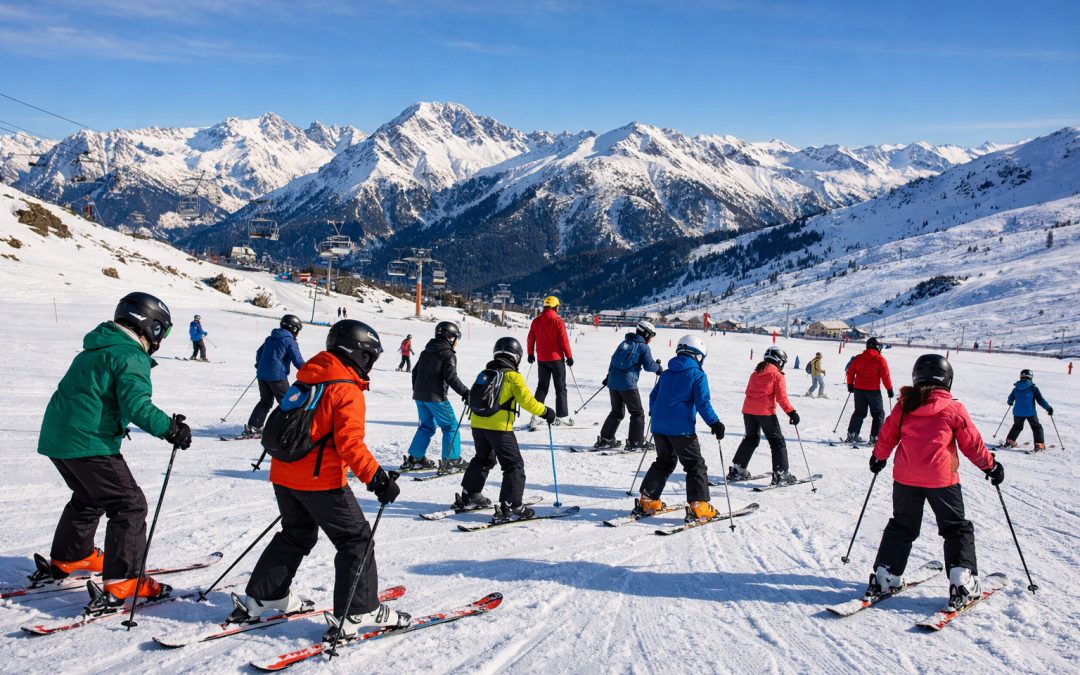
During the trip, the students take four hours a day of ski lessons taught by alpine skiing sports technicians, in addition to additional supervised skiing time. This concentrated intensity over several consecutive days allows for a technical progression that is difficult to achieve in isolated sessions.
Continued practice facilitates the improvement of balance, coordination, control of the body in movement and the understanding of safety rules on the court. The fact that the equipment is included – skis or boards, boots, poles and mandatory helmet – guarantees uniformity and safety.
In primary, this learning focuses on initiation and progressive adaptation to the mountain environment. In secondary school, technical progression is usually faster and autonomy increases, always under professional supervision.
Structured methodology: organized learning
Educational structure of the school trip to the snow
Technical activity → 4 hours a day of skiing with sports technicians
Continuous monitoring → Certified monitors + track control
Coexistence → Shared rooms + night activities
Organized routine → Structured schedules throughout the stay
Safety → Medical service at the station + insurance included
The trip is not limited to the hours on the track. The daily structure is designed to generate order and stability:
Breakfast organized at the hotel.
Transportation to the station.
Technical classes.
Lunch on the slopes.
Afternoon activities.
Dinner and evening dynamics led by qualified instructors.
Rest until the next day.
This constant routine teaches students to organize themselves, respect schedules and adapt to a different environment than usual. Daily repetition reinforces habits and discipline.
Coexistence as a pedagogical tool
Sharing a room, taking turns, organizing common spaces and participating in group activities generates a context of real coexistence.
Students learn to resolve small daily conflicts, to cooperate and to live together outside the family environment. The afternoon activities and night dynamics led by monitors qualified in leisure and free time reinforce this group cohesion.
The shared experience strengthens the feeling of belonging to the group and improves the relationship between colleagues.
Autonomy and personal responsibility
A school trip to the snow forces students to take on practical responsibilities: prepare their thermal clothing, organize their equipment, take care of the rented material and comply with the established schedules.
These everyday actions develop personal autonomy in a supervised environment. It is not about absolute independence, but about guided learning within a secure framework.
Security and controlled environment
The choice of destination is decisive. Resorts such as Boí Taüll offer a structure suitable for school audiences: a large beginners’ area, slopes with comfortable progression and all converging at the base, which facilitates supervision.
The trip includes medical assistance and accident insurance, as well as the possibility of taking out optional cancellation insurance. The presence of medical service at the foot of the slopes provides an additional environment of tranquility.
The approximate ratio of 1 monitor for every 25 students during organized classes allows adequate monitoring of the group on the track.
Organizational transparency and institutional trust
Distribution of responsibilities
Educational center: pedagogical accompaniment, internal management and communication with families.
Organizing agency: logistics, reservations, material, sports technicians, monitors, coordination at destination and insurance.
The organization includes hotel accommodation with supervised distribution, full board buffet type, equipment rental, sports technicians, qualified monitors and insurance included.
Clarity in payment conditions – including a split option – facilitates communication with families and reduces administrative tensions for the school.
This structure allows the accompanying teachers to maintain pedagogical control while the agency manages logistics and technical coordination.
Emotional impact and self-improvement
Emotional learning is one of the most significant outcomes. Facing a new sport means overcoming initial insecurities. Daily repetition and progressive improvement build confidence.
Students experience the direct relationship between effort and progress. This process strengthens self-esteem and the ability to adapt.
The school trip to the snow is a comprehensive educational experience when it is supported by planning, professional supervision, and organized structure.
It combines technical learning, coexistence, autonomy, discipline and emotional development in a safe environment.
Are you considering organizing a school trip to the snow for your school?
Request information and find out how we structure each experience so that it provides real educational value.


