
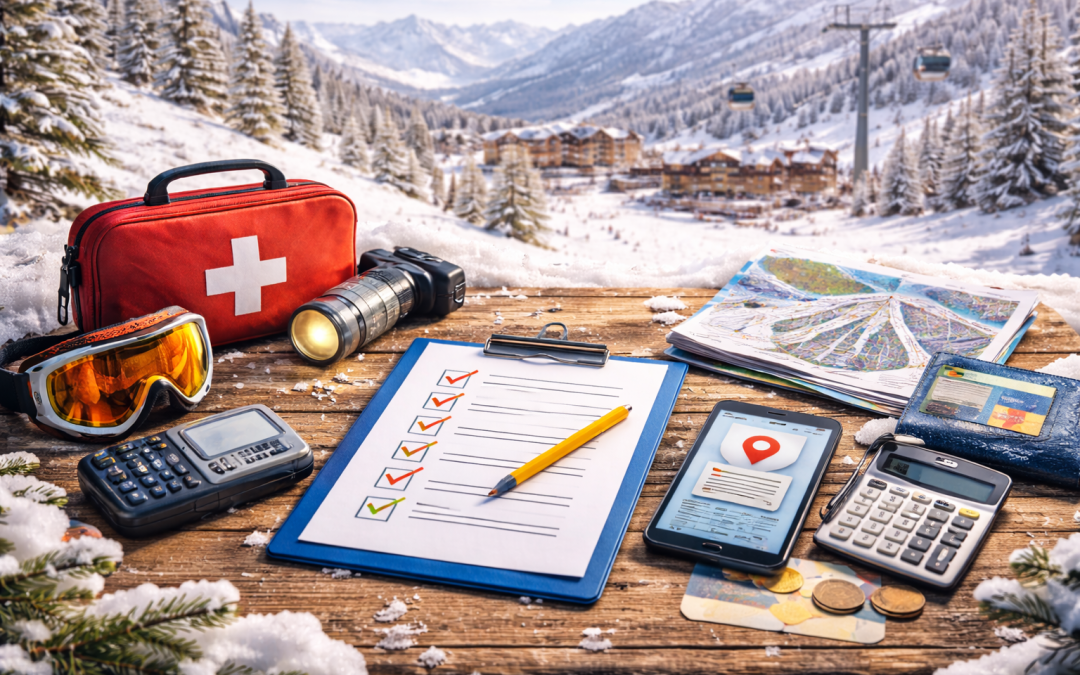
When an educational center decides to organize a school trip to the snow, the challenge is not only in “choosing a destination”. The real challenge is to manage the entire process in an orderly manner: justify the activity, validate safety and responsibilities, coordinate families and payments, and ensure that the experience is viable for the accompanying teachers.
In practice, many trips are bogged down by recurring problems: lack of clear information for families, uncertainty about insurance and protocols, doubts about ratios and supervision, or a poorly defined internal calendar. Therefore, having an operational checklist helps to make decisions with less stress and avoid duplicate work.
This article is designed for management teams, cycle coordinators, tutors and teachers responsible for outings. It includes a step-by-step process to plan and approve the trip, with a realistic approach and aligned with the type of program offered by Alpino Club (organized trip for centers, with structure, classes and coexistence).
1) Define the pedagogical objective of the trip
Before comparing proposals, the school must be clear about what it is looking for with the trip. This is not bureaucracy: it is what allows coherent decisions to be made and to defend the way out before families and the governing body.
Common objectives that the school can achieve:
Sports learning: initiation or improvement of technique in alpine skiing.
Coexistence: strengthening the group-class bond outside the classroom.
Autonomy: developing personal responsibility in a different environment.
Educational experience: learning outside the classroom, nature and healthy habits.
When the goal is clear, it is easier to decide on the type of station, the format of the program, the number of days, and the style of communication to families.
Diagram: Goal-Aligned Decision
2) Identify the internal audience and the approval circuit
In many schools, a multi-day trip requires validation of the trip at different levels: coordination, management, school council or equivalent body. If the approval circuit is defined late, calendar locks appear.
Operational recommendation: before asking for quotes, define who should give the ok and what information they need to approve:
Management: safety, responsibilities, costs, schedule, ratio, supplier.
Pedagogical coordination: fits in with the educational project and level of the students.
Tutors and accompanying teachers: real logistics, schedules, daily dynamics.
Families: what is included, material, payments, insurance, rules.
This prevents the trip from being approved “halfway” and then having to remake decisions.
3) Gather the minimum data to request a quote
To request an operating budget that is not “generic”, the centre must prepare a minimum set of data. If information is missing, the supplier will have to assume things and the budget will not fit well with the reality of the group.
Minimum recommended data:
Approximate number of students and course/cycle.
Preferred dates or date windows.
Duration (number of days).
Preferences of the school: prioritizing learning, coexistence, etc.
Specific needs (if any): e.g. internal logistical aspects of the centre.
With this, the provider can adjust the proposal and the center will be able to compare options with more criteria.
4) Validate the “hard core” of the program
A school trip is based on an operational core that should not remain ambiguous. If these elements are clear, the rest is easier.
In an organized program such as that of Alpino Club, the core points are:
Ski lessons: 4 hours a day with alpine skiing sports technicians are contemplated.
Supervision and coexistence: it is covered by monitors qualified in leisure and free time for complementary activities.
Equipment: equipment rental (skis or board, boots, poles) and mandatory helmet is included.
Insurance: Medical assistance and accident insurance included and optional cancellation insurance option.
Station: Boí Taüll as a destination, with useful elements for groups (beginners’ area, confluence, medical service).
These elements allow the center to justify the trip more solidly and answer common questions.
The operational core of the journey
5) Confirm ratios and distribution of functions
On school trips, many doubts arise due to a mixture of concepts: “monitor”, “teacher”, “technician”, “companion”. For the journey to be operationally sound, it is important to define the distribution of roles.
In the model described by Alpino Club, there are differentiations:
Sports technicians: they teach alpine skiing lessons.
Qualified monitors in leisure and free time: they manage complementary activities and coexistence.
Accompanying teachers: general pedagogical supervision and coordination of the school group.
In classes organized on the track, an approximate ratio of 1 monitor for every 25 students is handled, which gives a frame of reference for the supervision and control of the group during the sports activity.
6) Review the “family pack”: what the school needs to communicate
Experience says that a center does not have time to rewrite long documents. What you need is a clear, reusable set of information: what the trip includes, what personal equipment students should bring, how the insurance works, and how payments will be arranged.
Minimum content that the school should have ready:
Program Overview: Days, Structure, Classes, Activities.
What is included in the price: equipment, helmet, insurance, accommodation and board.
What the student should bring: warm clothes, gloves, etc.
Payments: payment schedule if there is payment in instalments.
Basic rules: conduct, schedules, coexistence.
If the school has an operational dossier (such as the one used to prepare the previous articles), the ideal is to extract blocks “adapted to blogs” and “adapted to families” from there without mixing formats.
7) Ensure that accommodation fits in with school dynamics
On a school trip, accommodation must support coexistence. It is not a secondary detail. The organization becomes much more complex if the accommodation does not allow for orderly schedules, group control and adequate rest.
In the program described, accommodation is planned with full board buffet style. This format facilitates meal management, reduces incidents and improves the group’s daily logistics.
The center should review:
Meal plan and schedules.
Distribution of the group for sleeping and supervision.
Evening routine and guided complementary activities.
8) Validate the “administrative” part before opening registration
A typical source of problems is opening registration without having closed the basic points: dates, final price, what’s included, payments and cancellation. That generates constant noise and doubts.
Before opening registration, it is advisable to have defined:
Final price per student (and what exactly it includes).
Payment in instalments, if offered, and internal calendar.
Optional cancellation insurance: if proposed, how it is communicated.
Deadlines: registration deadline and confirmation date.
When these points are clear, the school reduces friction and teachers avoid managing improvised “individual cases”.
9) Design a realistic internal calendar
A school trip usually involves an internal calendar: asking for a budget, approving it, communicating it to families, registering, confirming payments, preparing material and executing the trip.
If the calendar is too tight, the school suffers saturation in the weeks leading up to it.
Operational recommendation: divide the process into phases, with clear milestones. For example:
Phase 1: Request for proposal and internal validation.
Phase 2: communication to families and opening of registration.
Phase 3: closure and operational confirmation.
Phase 4: preparation (personal material, rules, coordination).
Phase 5: Implementation and monitoring.
Diagram: process phases
10) Preparing students: rules and expectations
A school trip works best when students understand what is expected of them. That reduces conflicts and improves coexistence.
Elements to be defined and communicated:
Rules at the resort: follow directions, do not separate from the group, respect on ski lifts.
Rules of coexistence: respect in rooms, schedules, rest.
Daily routine: structure of the day and key moments.
This does not require a huge “manual”. It requires clarity and consistency with the actual schedule of the trip.
11) Preparation of personal material
Although technical material is included in the program, the student must wear appropriate clothing. If the school communicates this in advance, forgetfulness that generates problems at the destination is reduced.
Recommendation: communicate a basic and practical list (without turning it into an endless list). For example:
Layered clothing (thermal + mid-layer + waterproof jacket/pants), gloves, sun protection and glasses.
The center can supplement this with a small reminder that the helmet is included and mandatory, for the avoidance of doubt.
12) During the Journey: How to Reduce Operational Friction
During execution, the center’s goal is for the day to flow with as little friction as possible. There are simple decisions that help:
Fixed meeting point and clear schedules at the station.
Internal coordination between teaching staff and team of monitors.
Clear communication channel for internal incidents.
The daily structure (classes, food, afternoon and evening activities) reduces improvisation and facilitates group control.
13) After the Trip: Closure and Learning
Closing the trip is also part of the process. Making a simple closing helps the school to improve future editions and consolidate the educational value of the activity.
Closing ideas (without adding bureaucracy):
Debrief with the group: what they have learned, what has gone well.
Internal feedback from accompanying teachers: what to improve.
Communication to families: positive closure and gratitude.
Printable Summary Checklist
Before asking for a quote
Define pedagogical objective, approximate number of students and dates.
Before approving
Validate operational core: 4h classes with technicians, qualified instructors, equipment and helmet, insurance included, optional cancellation, Boí Taüll station.
Before you open enrollment
Confirm final price, what is included, payment in instalments if applicable, deadlines and communication to families.
Know before you go
Rules of coexistence, personal material, schedules and internal coordination.
After
Debrief and closing.
Conclusion
A well-planned school trip to the snow is a high-value educational experience. But for it to work, the center needs a method: define objectives, validate the operational core, organize internal approval, communicate with families and execute with structure.
When the proposal is designed for educational centers, with sports technicians, qualified monitors, equipment with helmets, insurance included and a suitable station such as Boí Taüll, the center gains in tranquility and the trip becomes a training activity that really pays off.


