
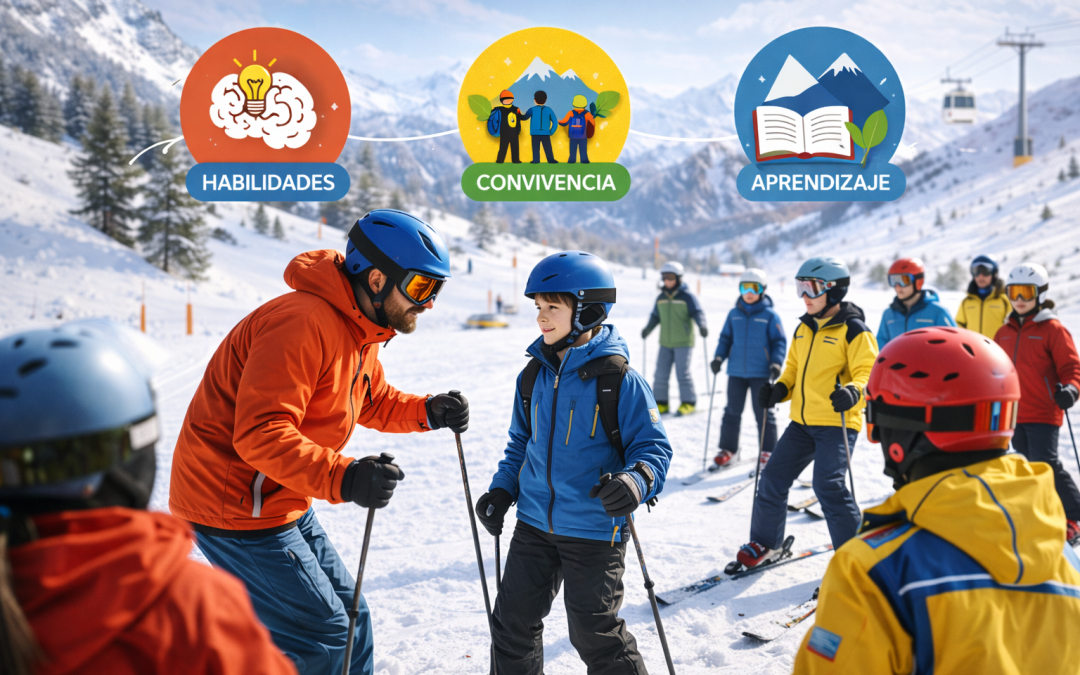
School trips to the snow are not only a sports or recreational activity. In fact, they represent one of the most complete educational experiences that a group of students can live during their school years. Skiing combines physical learning, emotional development, coexistence, autonomy and direct contact with nature. For this reason, many schools incorporate ski trips into their annual educational project.
When a school trip is well planned, the experience becomes a real educational laboratory outside the classroom. Students learn to function in a different environment, discover new skills, learn to live for several days with their classmates and develop personal skills that are difficult to work on in the usual context of school.
Programmes organised by specialised companies such as Alpino Club are designed precisely with this objective: that the school trip is not just a one-off activity, but a training experience that combines sport, education and coexistence.
Experiential learning: learning by doing
One of the most valued educational models today is experiential learning. This approach argues that students learn best when they actively participate in the experience. Instead of just listening to or memorizing information, students experiment, test, make mistakes, correct and improve.
School skiing fits perfectly into this pedagogical model. Learning to ski requires continuous practice, concentration, adaptation to the terrain and progressive learning. Each descent down the slope becomes a small practical lesson where the student puts into play their balance, coordination and ability to react.
In addition, learning to ski takes place in a real environment. It is not a simulation or a theoretical activity. The student lives the experience directly and that makes the learning more meaningful.
Development of personal autonomy
One of the clearest educational benefits of a school trip to the snow is the development of autonomy. For several days, students must adapt to a different routine from that of the school.
Students have to organize their clothes, manage their material, comply with schedules and follow instructions for the correct functioning of the group. This personal responsibility strengthens their maturity and organizational skills.
During the trip, students learn how to:
- Prepare your equipment before going out on the slopes.
- Manage your ski clothing and equipment.
- Respect common group schedules.
- Adapt to rules of coexistence.
- Make small personal decisions.
Many teachers emphasize that after a school trip, students return with greater autonomy and personal security.
Teamwork and coexistence
The school trip also reinforces coexistence between classmates. For several days the students share accommodation, meals, travel and activities. This continuous coexistence allows strengthening relationships between classmates who may not interact so often in the classroom.
Learning to ski also encourages cooperation. Students often encourage each other, share struggles, and celebrate the group’s progress. These types of experiences generate very positive bonds within the group.
Self-improvement and self-esteem
Learning to ski involves facing a completely new challenge for many students. Balancing on skis, learning to turn, or controlling speed are skills that require practice.
The learning process is usually progressive. At first the movements are complicated, but little by little the students gain confidence and control. This process generates a very positive feeling of self-improvement.
When a student discovers that he is able to descend a track that at first seemed difficult, his self-confidence increases. This positive effect is also transferred to the academic field.
Physical education in a real environment
Skiing is a very complete physical activity. It works on coordination, balance, endurance and muscle strength. It also requires constant concentration and adaptation to the terrain.
Practicing sport in a natural environment such as the mountains brings additional benefits. Students exercise outdoors, in a different environment than the usual gym or sports court.
For many students, the school trip is the first contact with winter sports. This experience can spark interest in new sports activities.
Contact with nature and environmental education
The mountain is a natural environment that offers unique educational opportunities. During a school trip to the snow, students discover different landscapes, learn to respect the natural environment and become aware of the value of mountain ecosystems.
Direct contact with nature has positive effects on emotional well-being. Being surrounded by open landscapes, clean air, and natural silence helps reduce stress and improve mood.
Many school ski programs also incorporate content related to environmental education, explaining aspects such as the mountain climate, local fauna or the impact of climate change.
Improved group dynamics
One of the most interesting effects of school trips is their impact on group dynamics. Living together for several days allows students to get to know each other better, overcome conflicts and develop more positive relationships.
After the trip, many teachers observe improvements in the classroom environment. The students have shared an intense experience that strengthens the feeling of group.
Development of social skills
During the trip, students constantly interact with classmates, teachers, instructors and ski resort staff. This interaction fosters important social skills such as communication, respect, and cooperation.
In addition, students learn to function in a new environment where they must follow specific rules of behavior.
Learning to manage emotions
Skiing also involves managing emotions. Students experience excitement, nervousness, initial fear, or satisfaction in improving. Learning to manage these emotions is part of the educational process.
Overcoming small sporting challenges helps to develop resilience and adaptability.
Global Educational Benefits
All these elements make the school trip to the snow a very complete educational activity. The student learns, lives together, moves, discovers new environments and develops personal skills.
An experience that students remember for a lifetime
School trips often become one of the most important memories of the educational stage. Skiing also adds the component of adventure and discovery.
For many students, their first trip to the snow represents an experience they will remember for years. Not only for sports learning, but for the coexistence with their teammates and the emotions experienced.
Conclusion
School skiing is much more than a sporting activity. It is an educational tool capable of developing autonomy, improving coexistence, strengthening self-esteem and bringing students closer to nature.
When the trip is well organized and has specialized professionals, the experience becomes a unique learning opportunity outside the classroom.


