
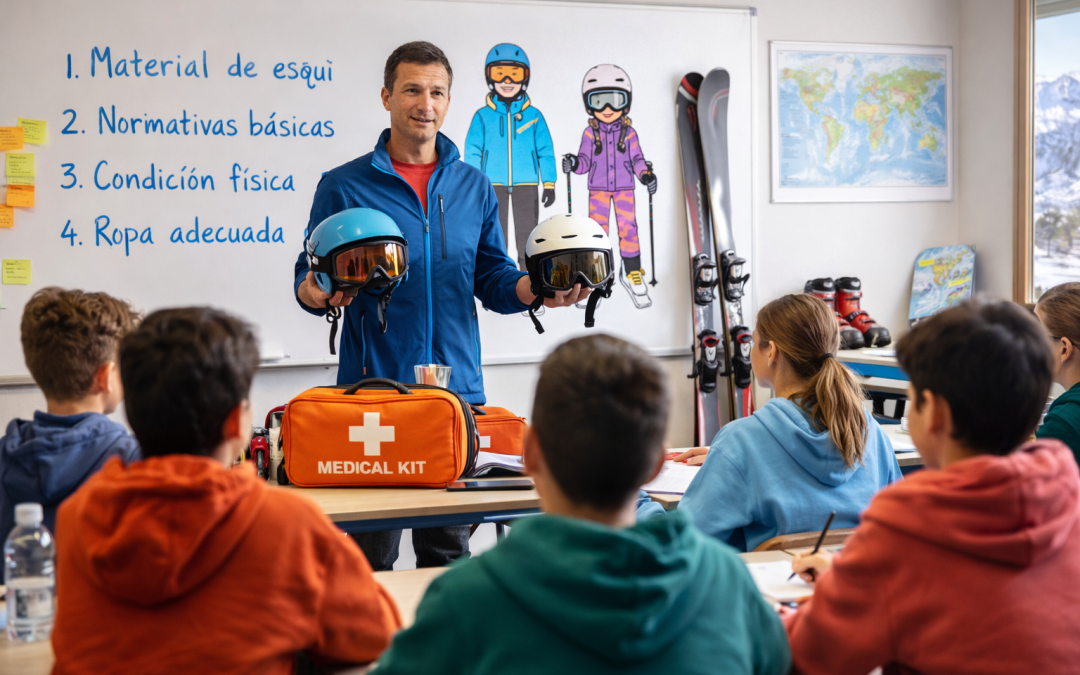
Organising a school trip to the snow involves much more than booking transport and accommodation. A good preparation of the group beforehand makes the difference between a chaotic experience and a safe, organized and enriching educational activity.
When an educational center prepares its students correctly before the trip, risks are reduced, coexistence is improved and learning time on the slopes is optimized. In school ski programs such as those organized by Alpino Club, prior preparation is a key element for the trip to run smoothly from day one.
Why it’s important to prepare your trip before you leave
For many students, a school ski trip will be their first experience in the snow. This means facing a completely new environment: low temperatures, technical equipment, safety standards on the track and a daily dynamic that is different from the usual school environment.
If students understand in advance how the trip will work, what material they will use and what behaviour is expected in the ski resort, the level of adaptation is much faster.
Prior preparation allows:
- Reduce student uncertainty.
- Improve safety on the slopes.
- Optimize learning time.
- Facilitate the work of monitors and accompanying teachers.
Explain what the day-to-day of the trip will be like
One of the best ways to prepare a school group is to clearly explain what the daily routine will be like during the trip. Students should know that the day will have an organized structure that combines sports, coexistence and educational activities.
A typical day on a school ski trip usually includes:
- Breakfast at the accommodation.
- Organized travel to the station.
- Ski lessons with sports technicians.
- Lunch on the slopes or restaurant at the resort.
- Return to the accommodation.
- Guided afternoon or evening activities.
When students know this structure before the trip, the group’s behavior improves and adaptation is faster.
Explain basic safety rules
Another fundamental aspect of the previous preparation is to explain the basic rules of safety in the snow. Skiing is a safe activity when practiced correctly, but it requires respecting certain basic rules.
Before the trip, it is advisable to explain to the students:
- The importance of always following the instructions of the monitor.
- Why it is mandatory to wear a helmet.
- How to behave on the ski lifts.
- Why they should not leave the group.
- How to act if they fall or separate from the group.
Prepare the necessary material
Many students have no experience with ski equipment, so it is important to explain beforehand what equipment they will use and how it works.
On trips organised by Alpino Club, technical equipment is usually included and delivered directly to the resort, which greatly simplifies logistics for schools.
The basic ski equipment includes:
- Skis or snowboard.
- Boots.
- Canes.
- Helmet mandatory.
In addition to the technical material, it is important to remind students what clothes they should wear: thermal clothing, waterproof gloves, sunglasses or snow mask and sunscreen.
Preparing students physically
It is not necessary to have specific physical preparation to participate in a school ski trip, but it is recommended that students arrive with minimal physical activity.
During the weeks leading up to the trip, you can do physical education activities that help prepare the body for the effort: balance, coordination, or basic resistance exercises.
This makes it easier to adapt to the first ski lessons and reduces initial fatigue.
Properly informing families
Preparing for the trip also involves maintaining clear communication with families. Informing in advance about the travel program, the necessary equipment and the conditions of the accommodation helps to build trust.
Many schools organise a small briefing before the trip to explain:
- The program of the trip.
- Security measures.
- The necessary material.
- The conditions of the accommodation.
- Insurance included in the activity.
Create positive expectations
Finally, preparing the trip also means generating enthusiasm in the students. Skiing is a sporting activity that combines learning, nature and coexistence. When students arrive motivated on the trip, the experience is much more enriching.
Explaining what the experience will be like, showing pictures of the station, or commenting on the activities that will be done during the trip helps to create a positive atmosphere before leaving.
Conclusion
Preparing a school group before their first ski trip is an essential part of the organizational process. Explaining the structure of the trip, the safety rules, the necessary equipment and the daily dynamics allows students to arrive at the snow with confidence and that the experience is much more positive for everyone.


